A woman in vintage attire stands by a softly lit wall, wearing a wide-brimmed hat.

2 year-old Lylah Koob’s Death & Why (from the Safe Passage Report)

This is one of the 88 stories of children dying at the hands of their caregivers reported in the recent Safe Passage For Children investigation of child death in Minnesota. The report suggests why this tragedy is happening in our state and how we can make life safer for at risk children (in the read more at the end of the article). Lylah Koob, Goodhue County

Details
Two hands gently holding each other in a comforting gesture.

2 Year-Old Sophia O’Neill Death & Why (from the Safe Passage Investigative Report)

This is one of the 88 stories of children dying at the hands of their caregivers reported in the recent Safe Passage For Children investigation of child death in Minnesota. The report suggests why this tragedy is happening in our state and how we can make life safer for at risk children (in the read more at the end of the article). Please share this with your contacts and State Representative. Sophia O’Neill, Hennepin County

Details
Sign advocating for social justice and children's rights.

International Rights of the Child Treaty (& why jails are full)

Over 25 years ago the rest of the world (194 nations) decided that children have basic human rights and begin signing the International Rights of the Child Treaty. Under this document, children are to have the rights to education, safety and well being including not to be made soldiers, not to be enslaved).

America is the only nation that has not signed that agreement, largely because we still demand that southern states continue to militarize youth as young as eleven, through military schools.

Details
Indoor party with toddler and adults

Adoption & Foster Care In America – (their stories, your state)

Foster Care; Every state is struggling to make life safe for traumatized state ward children. Here are their stories from October & November 2017;

KS: Nowhere Else to Go: Why Kids Are Sleeping in Child Welfare Offices (Commentary)

Governing – October 11, 2017

Every month, there are kids in Kansas forced to sleep on cots or couches in a foster care contractor’s office because they don’t have anywhere else to stay that night.

All Adults Are The Protectors of All Children

Details
Bar chart showing annual public spending per child on early childhood care by country.

Politics & Children – A Zero Sum Game

A recent MN Governor ended subsidized daycare in the state – the waiting list went from 34 families to 7000.

At the time, two percent of MN children were enrolled in high quality early childhood education programs- the national average was 25% and MN had the lowest rate among the 38 states that offer the programs.

Cutting the pie smaller for children is destructive, leads to failing students and schools, troubled communities, and the highest crime rates in the industrialized world.

Details
Silhouettes of people standing on a gun barrel.

Arming Teachers/Shooting Students (advocating for less violence and a more civil society)

After the COVID19 lockdowns are lifted, and children and teachers return to the the classroom after months of fear and isolation, wouldn’t it be wonderful if students and teachers do not have to replace the daily fear of a virus with the daily fear of violence? 

What can the community do to make that happen?

How many teachers have combat training or signed up to pack a weapon when they entered the profession?  Turnover in education is already a huge problem.  Packing a gun is what police and soldiers do. Shooting someone takes training – shooting the right person takes extensive training.  For decades now, guns have been more often used for suicide than self-defense in America.  This is true also for domestic violence.

Details
A woman with a serious expression holds up her hand as a stop gesture.

MN Has 3rd Highest Sex Trafficking Cases in U.S.

January is Human Trafficking Prevention Month Odds are, you know somebody sex trafficking has impacted.  Minnesota has the third highest number of human trafficking cases in the U.S. annually.  The Twin Cities have the 13th highest rate of child prostitution. Common targets of sex traffickers are abused & homeless children and people with addiction, and mental…

Details
Empty swing hanging in a dark, moody playground at night.

Childhood Trauma Is a War Injury: How ACEs Rewire the Brain and Fuel Crime

Childhood trauma and Post‑Traumatic Stress Disorder (PTSD) in war veterans look different on the surface—but biologically, they are strikingly similar. We accept that a soldier torn apart by bullets or standing next to a friend killed by a bomb will carry invisible brain injuries. Yet we still struggle to see how growing up in a violent, chaotic, or deeply neglectful home can damage a child’s brain in many of the same ways.

Details
A young girl with messy hair looks sad in front of a blackboard with emotional writing.

Common Misconceptions About CPS, Debunked

Public opinion about Child Protective Services is shaped by powerful myths that rarely match reality. Drawing on research summarized by Safe Passage for Children of Minnesota, this article challenges common misconceptions about CPS, child removals, racial bias, poverty, and foster care outcomes—and explains why evidence based, child centric policies are essential for at risk children and for the workers trying to protect them.

Details
Silhouettes of a family with two adults and one child.

Children Are Failing In CPS: This is Why and How To Fix It

America’s child protection system is failing the very children it was built to save. Instead of preventing abuse, neglect, and family destruction, CPS has become part of the machinery that fills prisons, shatters families, destabilizes classrooms, and overwhelms our health‑care system with preventable trauma, mental illness, violence and addiction. Wrapped in layers of conflicting privacy rules and starved of honest data, child protection agencies hide more than they reveal—leaving lawmakers to make life‑and‑death decisions in the dark, social workers crushed under impossible caseloads, and at‑risk children returned to dangerous homes or lost in a foster care maze that rarely heals the damage already done.

Details
A woman with a serious expression holds up her hand as a stop gesture.

When Is Child Abuse a Crime

Child abuse in the home is still too often treated as a private family issue instead of a crime. Drawing on years as a CASA guardian ad Litem, this post exposes how Child Protective Services keeps abuse hidden, why children have no standing in court, and what must change so kids are truly safe in their own homes.

Details
Child trapped in a pill bottle with scattered capsules.

KARA Digital Toolkit: Free and Low Cost Tech for Traumatized Children and Teens

KARA’s Digital Toolkit brings together free and low cost apps, trainings, and tech tools that help abused and neglected children cope with trauma and behavior problems. These resources are designed to support—not replace—professional care and can be shared with youth, caregivers, schools, and advocates.

Details
Two children playing outside near a brick building and wooden door.

How Foster Care and Group Homes Fail America’s Most Troubled Children

Foster care and group homes are supposed to protect our most troubled children, but for many they become another source of trauma. Youth in care face unstable placements, high rates of mental illness, overrepresentation in group homes, and far greater odds of homelessness, exploitation, and incarceration when they age out.

Details
Silhouettes of a family with two adults and one child.

How Alcohol, Drugs, and Poverty Drive Child Abuse: From Fetal Alcohol Syndrome to Criminal Neglect

Parental alcohol and drug abuse, especially in the context of poverty, is one of the strongest drivers of child abuse and neglect. From fetal alcohol spectrum disorders that injure children before birth to criminalized meth labs and chronic neglect, substance use reshapes a child’s brain, home, and future. This post explains how addiction, poverty, and policy collide to harm children — and why real solutions must treat substance use as both a child protection and public health crisis.

Details
A woman with a serious expression holds up her hand as a stop gesture.

“Safety” at Home, Rape in Secret: The Long Shadow of Caregiver Sexual Abuse

Sexual abuse of a child is rarely a single “incident” or the act of a stranger in the dark; for many children, it is years of rape by the caregivers who are supposed to protect them. Most child sex abuse occurs in the home. This CASA Guardian ad Litem has experience two four-year-olds coming into…

Details
Logo for Kara, Kids at Risk Action organization.

America’s Child Abuse Emergency: 546,000 Victims, 2,000 Deaths, and a System That Chooses This

Child abuse in the United States is not rare or random — it is the predictable outcome of policy choices. In 2023, about 546,000 children were confirmed victims of abuse or neglect and an estimated 2,000 were killed, roughly five children every day. Most are hurt by their own parents, often after prior contact with Child Protective Services. These numbers vary wildly by state, proving that our systems can choose to protect children — or not.

Details
Close-up of an eye with braided hair strands.

What School Counselors Can Do: Protect, Heal, and Empower Children

School counselors are often the only adults who truly see what traumatized students are living through. This article explains how trauma informed school counseling can spot abuse and adversity early, lead school wide change, coordinate crisis response, connect families to community support, and sustain counselors doing this work. With real world stories and a curated resource list, it’s a practical guide for counselors supporting students impacted by trauma and adverse childhood experiences.

Details
Children holding signs advocating for children's rights and voices.

Alex Miller’s Leadership Is Rebuilding Minnesota’s CASA Program

Minnesota’s Guardian ad Litem and CASA program has been under real strain—lost volunteers, rising caseloads, and stressed systems have put vulnerable children at risk. Alex Miller’s Minnesota CASA leadership as Chief Information Officer and Interim Program Administrator is helping move the program from crisis toward recovery. By modernizing technology, strengthening data security, and working transparently with the State Guardian ad Litem Board, he has helped stabilize turnover and rebuild trust. The result is a system that is slowly regaining its footing and putting more trained, supported advocates in the lives of abused and neglected children.

Details
Logo of Invisible Children with a brick wall and child illustration.

Child Endangerment (Star Tribune “IN HARM’S WAY”)

Minnesota’s child protection system is repeatedly returning severely abused children to unsafe homes — and some are dying as a result. Drawing on the Star Tribune’s “In Harm’s Way” investigation, Safe Passage’s child fatality data, and my experience as a CASA guardian ad litem, this post exposes how opaque CPS practices, ignored warning signs, and a lack of accountability keep kids in danger. Learn what’s going wrong, why it matters for every Minnesotan, and how you can help push lawmakers to finally put children’s safety first.

Details
Two children focused on writing in a notebook together.

Part 3: Scaling the “Minnesota Model” for Maximum ROI Impact

Market-based scholarship programs like Minnesota’s Early Learning Scholarships (MELS) prove these returns are scalable. MELS provides vouchers to low-income parents, empowering them to choose high-quality programs. Result: an 18% inflation-adjusted public ROI—higher than the S&P 500’s historical average111210. The keys to replicating this success are: Targeting at-risk children: Returns exceed $17 per dollar in high-poverty neighborhoods7. Parent empowerment:…

Details
Children of diverse backgrounds holding hands around Earth.

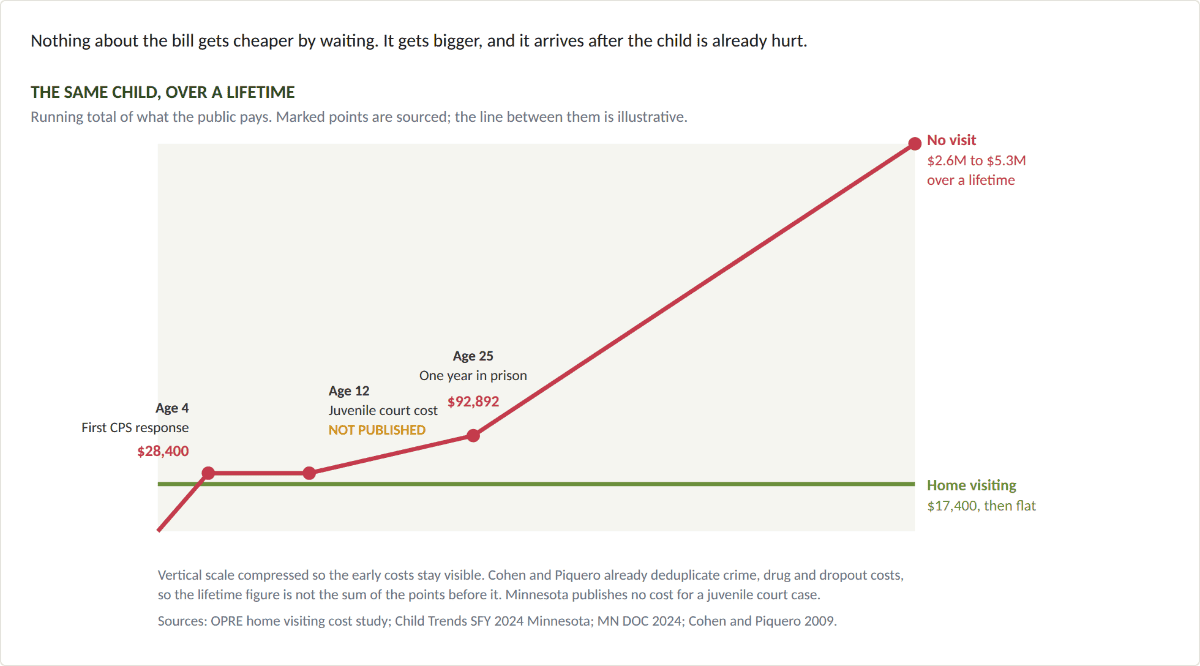
Part 4 of 5: Why Early Childhood Investment Outperforms Remedial Spending

Compared to other government expenditures, early childhood programs are uniquely cost-effective. K–12 education spends ~$15,000/student annually with diminishing returns; prison systems cost $40,000/inmate yearly with high recidivism. Meanwhile, early childhood interventions like Head Start save $4.8B–$16.1B per

Details
Two hands gently holding each other in a comforting gesture.

Tip of the Mental Health Iceberg (podcast)

Kids at Risk Action, the hosts address the growing mental health crisis in child welfare, particularly in emergency rooms and foster care systems. They reveal alarming statistics, such as the significant rise in ER visits for children’s mental health crises and the systemic failures that leave many without proper care.

Details
Illustration of trauma's impact on person, family, and people, emphasizing decontextualization over time.

Northeastern University Study on the Child Welfare Crisis With Projections

Official child welfare numbers may capture only part of the crisis. This analysis explains how poverty, Family Assessment practices, underreporting, misreporting, and weak transparency can hide the true scale of harm to children—and why future projections must account for what the system fails to record.

Details
Silhouette filled with negative words reflecting self-doubt and low self-esteem.

Foster Child Self-Harm & Suicide June 2025

Childhood trauma, suicide and self-harm among American youth are at historic highs, with alarming increases among fosters, preteens, girls, LGBTQ+ youth, and children of color. Suicide is now the second leading cause of death for ages 10–24, and nearly one in five high school students has seriously considered suicide in the past year. Rates of self-harm, especially among young girls and LGBTQ+ youth, have surged, with emergency room visits for self-injury rising dramatically since 2020

Details
Teacher standing in a classroom with blue chairs, holding a notebook.

What Teachers Can Do: Trauma‑Informed Classrooms and Child Protection

TRAUMA INFORMED TEACHING, TRAUMA  INFORMED CLASSROOMS Teachers as Mandated Reporters and Frontline Defenders – Teachers are uniquely positioned—they often spend more awake hours with children than any other adult, especially for those from troubled homes. They are confidants, first responders, and witnesses to the silent suffering of abused, neglected, or traumatized students.

Details
Silhouette filled with negative self-descriptive words representing low self-esteem.

Very Young Children, Suicide, and Abuse: What We, CPS, and Lawmakers Must Do

Very young children are showing up in emergency rooms after suicide attempts and self‑harm, often with histories of abuse, neglect, and other trauma. When CPS and lawmakers lack transparent, child‑outcome data and trauma‑focused resources, these children slip through the cracks until it is too late.

Details
Silhouettes of a family with two adults and one child.

In Custody, In Crisis (podcast episode #1)

dive into the “ground truth” of the foster care system — exposing the often-unseen hardships children face even after being placed in protective care. Through heartbreaking stories like Alex’s and alarming statistics on abuse

Details
Black T-shirt with bold white text promoting kids' voices.

Why We Hide Child Abuse Data

Social workers face secondary trauma and burnout in a child protection system that hides basic child outcome data. When CPS agencies use HIPAA as a “red herring” to block even de identified information, lawmakers and communities can’t fix what’s broken—and children and workers continue to suffer in the dark.

Details
Silhouettes of a family with two adults and one child.

Recruiting Child Soldiers (yes, we do)

This article from 2013 is still true today with no signs of changing. It needs to be shared with your states lawmakers: The United States is the only nation that has not signed the United Nation’s International Rights Of the Child Treaty of the 1980’s.  A primary reason we refuse to sign the treaty is…

Details
Two children reading a book together on the floor.

Part 2: The Science Behind Early Childhood Returns (ROI)

The extraordinary ROI of early childhood programs stems from neurobiological and economic synergy. During ages 0–5, the brain forms 1 million neural connections per second, creating foundational skills that dictate lifelong learning, health, and behavior56. Programs like Child-Parent Centers leverage this plasticity: at-risk children receiving enriched preschool and parent mentoring achieved $10.83 in societal benefits per dollar spent by age…

Details
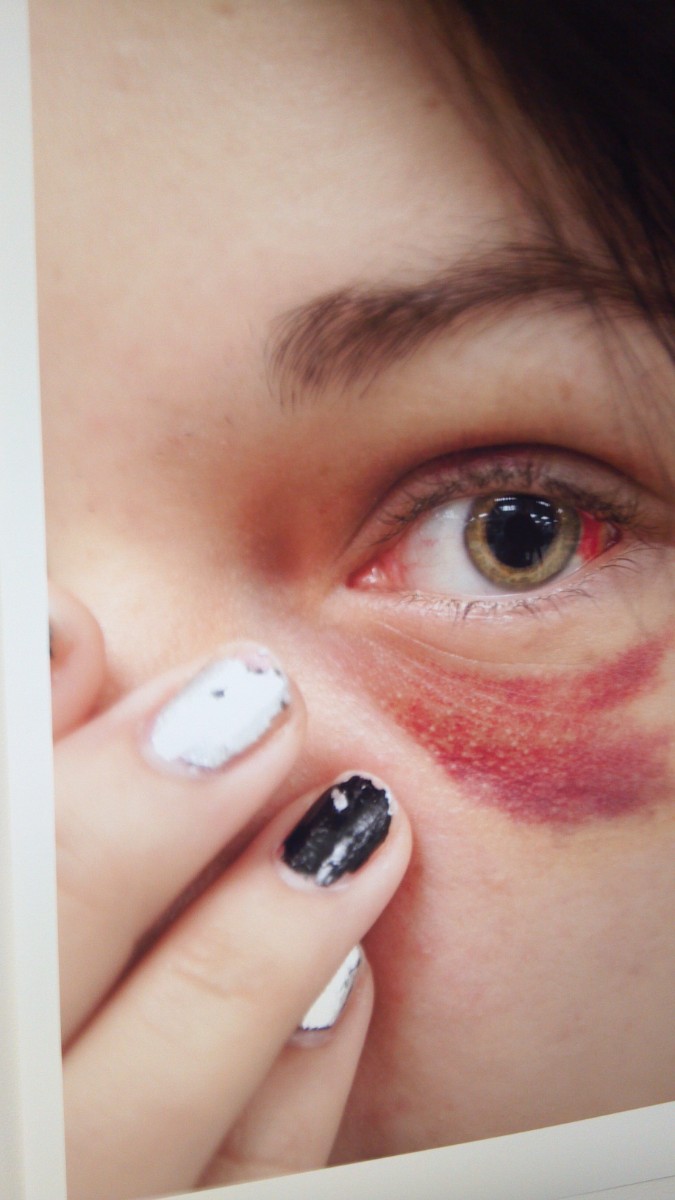
Close-up of an eye with a visible bruise underneath.

How Child Abuse and Trauma Sabotage Education, Public Health, and Public Safety

Child abuse redefines the way a child thinks and sees the world. Abused children have severely limited learning and coping skills. An abused child’s mental development has been arrested by an anxiety and fear that supercede the learning of other personal and social skills. Without personal and social skills, and a lessening of the anxieties and fears, Abused children fail at school, don’t make friends, and keep a terribly low self image.

Details
Three child silhouettes on white background

Invisible Cost Child Abuse ACEs Healthcare Impact

This post addresses the healthcare burden children with high ACEs scores have on our communities and nation. What’s not obvious to many is that at risk children become at risk youth and at risk adults. 9-year 80% prison recidivism has been with us for over 20 years. This single statistic shines a light on the cascading and forever financial and social costs to our communities from one other American institution that is easily understood. The health care financial and social costs are more complex and harder to understand. The Cape Breton University study below brings clarity to this complex issue.

Details
Silhouettes of a family with two adults and one child.

Deep Dive Into Northeastern University Child Welfare Crisis Research

This deep dive expands on KARA’s child welfare crisis post by walking through five Northeastern University capstone projects. Together, they use national data, infant mortality models, county level forecasting, and poverty analysis to show where children are most at risk—and how KARA AND YOU can use this research to drive policy change.

Details
Silhouette filled with negative self-descriptive words representing low self-esteem.