
This article is a deep dive into the cost of child abuse
and how to reduce it exponentially.
In October 2012, researchers started following 4,229 families. Every one of them was pregnant or had a baby under six months old. Every one of them was living with the kind of risk that gets a family flagged. Half the families got a home visiting program. A nurse or a trained visitor who came to the house, over and over, for years. The other half got a list of phone numbers for services in the community.
That is a randomized controlled trial, the same design we demand before approving a drug. In September 2025 the results came back from the kindergarten follow-up, five to six years after those mothers enrolled. The study is the Mother and Infant Home Visiting Program Evaluation, and any legislator or staffer can look it up.

The researchers wrote down eight questions before they started, so nobody could go fishing for a happy answer afterward. Five of those questions were about mothers and families. All five came back positive and statistically significant. Mothers coped better. Their mental and behavioral health improved. The way they interacted with their children improved. Their families’ economic circumstances improved.
And then there is the fifth one, which is the one I want every person who votes on a child welfare budget to sit with. The researchers grouped together outcomes related to conflict, violence, aggression, and maltreatment. That result came back positive too.
Fewer children hurt. Because somebody kept showing up at the door.
When I say we should send a nurse, I mean a visiting nurse or a visiting trauma-trained community mentor, whichever one that family will actually open the door for. Not both. One person, going to one house, over and over.
The trial tested four different programs, and only one of them sent registered nurses. The other three sent trained visitors who were not clinicians. So the idea that the visitor does not have to be a nurse is not mine. It is already in the evidence. What is mine is the argument that for a mother already inside the child protection system, the right visitor is often somebody from the community who has been where she is, and I will make that case further down.
I have watched advocates oversell a study and lose the room. The three questions about how the children themselves were doing came back weaker. Social-emotional functioning at home was significant and positive. The same pattern showed up in the school setting but did not reach statistical significance, possibly because fewer teachers responded. And on cognitive, language, and math skills, the test did not come back significant.
This is a program that measurably changes how a mother copes, how she parents, how much violence is in that house, and how much money is coming in. In a field where almost nothing survives a randomized trial, this is enormous.
Kathleen Blatz was the first woman to serve as Chief Justice of the Minnesota Supreme Court. Before the bench she was a legislator for eight terms and a psychiatric social worker. She spent her tenure pushing the courts to look harder at abused and neglected children, and she said two things that I have been repeating for most of my career.
The first: 90% of the youth in the juvenile justice system have come through child protection.
The second: the difference between that poor child and a felon is about eight years.
Sit with the second one. She is not describing a coincidence. She is describing a schedule.
A child gets referred to child protection at four. We investigate. We screen most of them out. Some we substantiate, and of those, some get services and some do not. Then that child turns twelve, or fourteen, and starts showing up in juvenile court, and everyone in the room treats it as a new problem with a new file.
It is the same child. We met him eight years ago. We had his address.
The Bureau of Justice Statistics tracked prisoners released from thirty state systems in 2005 for nine years. Five in six of them, 83%, were arrested at least once during those nine years. Those 401,288 people accounted for roughly two million arrests, an average of five apiece. And 60% of those arrests happened in years four through nine, which is to say after most follow-up studies had stopped looking.
Rearrest has barely moved in thirty years. We are somewhat better at not putting people back in cells. We are no better at all at keeping them out of trouble.
Which is what you would expect, if the thing that broke happened when they were four and nobody fixed it.
Now the money: what child abuse costs
In 2023, researchers at the CDC published what they found after surveying more than 820,000 adults about adverse childhood experiences. Abuse. Neglect. Witnessing violence. A parent locked up, or using, or unable to get out of bed.
About 160 million American adults, roughly 63% of us, carry at least one.
The economic burden they attached to the adult health conditions associated with those experiences was $14.1 trillion a year. This is health related costs only. Not crime, courts, CPS, or cost of incarceration.
Of that $14.1 trillion, $183 billion is direct medical spending, actual dollars moving through actual health systems. The other $13.9 trillion is lost healthy life-years, valued using the same statistical-life methods the federal government uses when it writes highway safety rules or clean air standards. It is a legitimate way to count. It is not cash sitting in a state budget line.
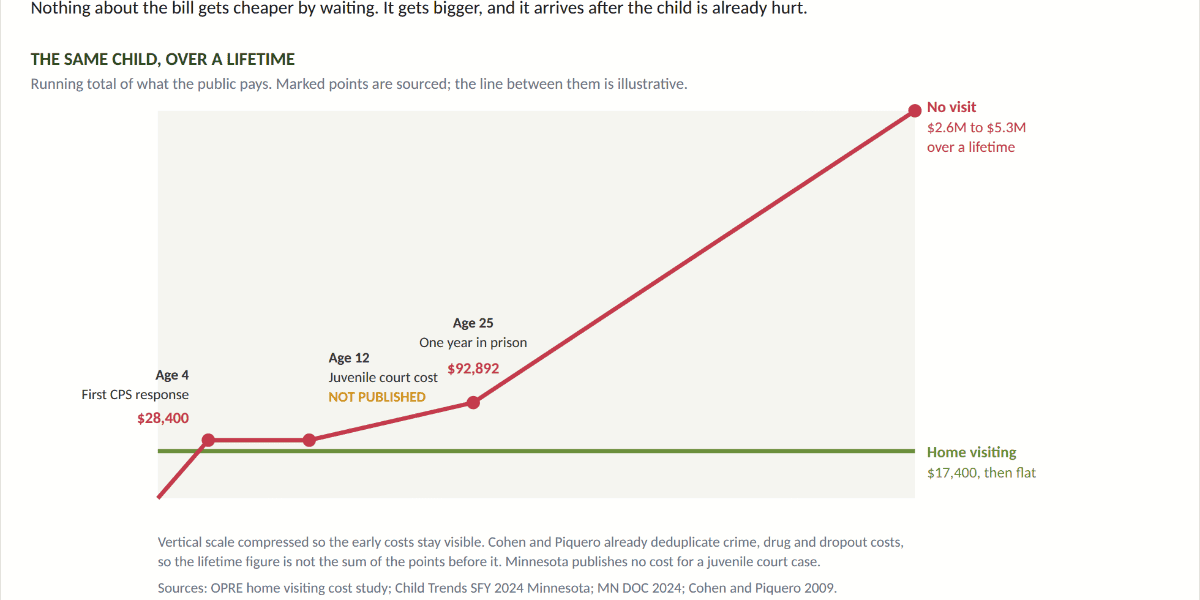
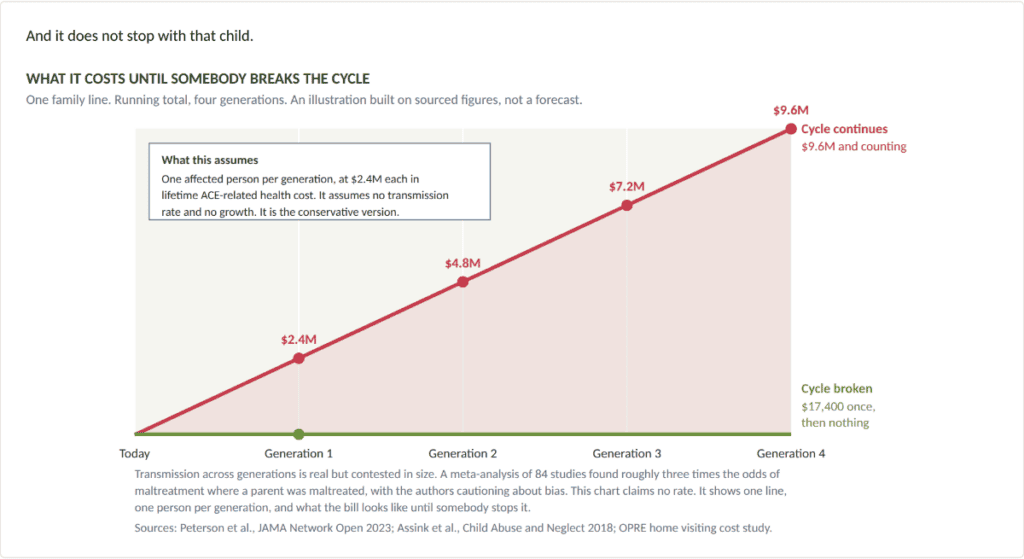
Both halves matter, and they matter differently. The $183 billion is what we are already paying. The $13.9 trillion is what we are throwing away. Per person, the study put it at about $88,000 a year for each affected adult, and $2.4 million over a lifetime.
Health care is one column. There are others.
Mark Cohen and Alex Piquero have spent years putting a price on a high-risk youth. Not a moral price. An accounting one, built from crime costs, drug costs, lost earnings, and what the public will actually pay to avoid all of it. Their estimate for saving one high-risk youth at age eighteen: $2.6 million to $5.3 million. Discounted back to birth, $2.6 million to $4.4 million.
Break out the pieces and it is still ugly. A career criminal alone, $2.1 million to $3.7 million. A heavy drug user, $370,000 to $970,000. A high school dropout, and this is somebody who never touches the justice system at all, $243,000 to $388,000.
Then add the columns nobody puts in a press release. The county caseworker’s hours. The investigation. The guardian ad litem. The judge, the courtroom, the county attorney, the public defender, the transcript. The out-of-home placement, the foster family, the group home, the residential facility. The special education services that follow a traumatized child through thirteen years of school. The emergency room visits. The state’s share, the county’s share, the federal match.
What Minnesota spends
In state fiscal year 2024, which ran from July 2023 through June 2024, Minnesota’s child welfare agencies spent $848,252,627.
That is county, state, and federal money together. Counties carried the largest share at $378.1 million. Federal sources came to $263.8 million. The state itself put in $206.0 million. Spending is up 7% from two years earlier and up 26% over the decade.
For that $848 million, 29,881 Minnesota children received a child protection investigation or an alternative response, and 9,992 spent time in foster care. That’s out of an average of 75,000 calls a year representing at least 150,000 children (meaning over half the calls are screened out).
Divide it out and you get about $28,400 for every child who got a response from the system. I want to be careful with that figure, because it is total agency spending divided by children investigated, not the price of an investigation. But it is the right order of magnitude, and it is the number that should be sitting next to the cost of a home visit.
The federal foster care line alone, Title IV-E, ran $73.0 million in 2024, up from $48.3 million two years before. Adoption assistance, $58.6 million. Guardianship assistance, $13.2 million. Medicaid dollars spent directly by child welfare agencies, $62.4 million.
Then the courts. Minnesota’s Guardian ad Litem Board received $53.5 million for the 2026-27 biennium, roughly $26.8 million a year, because federal law requires a guardian ad litem for every child alleged to be abused or neglected. Since 2023, parents who financially qualify have had the right to appointed counsel at every stage of a juvenile protection case, phased into Hennepin and Ramsey counties beginning in January 2025. That is a real new cost and nobody has published what it comes to.
One narrow slice shows what the expensive end looks like. Between 2018 and 2022, Minnesota sent 227 children to residential treatment facilities in other states. Those placements cost $21.6 million. In 2022 alone, 51 children cost $4.08 million, roughly $80,000 apiece for the year, and only $395,886 of it came back in federal reimbursement.
And here is the line I would put in front of every member of the Health and Human Services committees. Of that $848 million, the amount Minnesota’s child welfare agencies spent through the federal home visiting program was zero. The amount spent through the Title IV-E Prevention Program, which the state got approved back in 2023, was also zero. Kinship navigator, zero.
Minnesota already receives federal home visiting money. It runs through the health department, not through child protection. So the honest version is not that Minnesota spends nothing on home visiting. It is that the agencies spending $848 million a year on child protection and put none of it there.
Nobody can tell you what a case costs
Here is what I could not find, and I looked.
Nobody publishes what a child protection investigation costs in Minnesota. Nobody publishes what a CHIPS case costs to run through juvenile court. Nobody publishes a per-day cost of out-of-home placement broken out by placement type across the state. The last time the Legislature got a real county-by-county accounting of placement spending, it came from the Legislative Auditor in 1999.
We can tell you what the system spent in total. We cannot tell you what it spent per child, per case, per hearing, or per removal. Those numbers exist somewhere in eighty-seven county accounting systems and a case management database that the Legislature just appropriated $40 million to replace, and they have never been pulled together and published.
So every number in this piece is a floor, not a ceiling, and the pieces I most want to show you are the pieces nobody counts. The caseworker’s hours. The county attorney’s time. The judge and the courtroom and the transcript. The special education services that follow a traumatized child for thirteen years. The emergency room visits. The school hours lost. The foster family’s out-of-pocket. None of that is in the $848 million in any way you can separate out.
I have been asking for these numbers for a very long time. The fact that a state can spend $848 million on abused children and not be able to say what it costs to help one of them is not a technical problem. It is the reason nothing changes. You cannot compare the price of prevention to the price of the crisis if only one of them has a price tag on it.
What the far end costs
The Department of Corrections does publish its numbers, and they are worth putting next to everything above.
In fiscal year 2024, the average operational cost of holding one adult in a Minnesota prison was $143.95 a day. That is $52,542 a year, and it covers the direct things: security, food, clothing, medical and behavioral health, education. The department also calculates a second figure that state law requires, adding capital costs and a share of central administration. That one came to $176.69 a day, or $64,492 a year.
There were 8,306 people in Minnesota custody. At the operational rate that is roughly $436 million a year. At the statutory rate, roughly $536 million.
County jails run higher per person than most people expect. Across Minnesota’s jails the average was $261.42 per day based on actual daily population. Hennepin County’s adult detention center spent $56.5 million, Ramsey County’s $36.3 million.
Minnesota sits almost exactly at the national middle. State spending per prisoner in 2023 ran from just under $20,000 in Mississippi to $284,976 in Massachusetts, with a median of $60,989, and New York City’s Rikers Island is in a category of its own at roughly half a million dollars a person per year.
One year of one adult in a Minnesota prison, at the statutory rate, costs $64,492. Three full years of home visiting for one family runs somewhere between $3,900 and $17,400.
So the price of holding one person for one year buys three years of visits to somewhere between four and sixteen families.
And 95 percent of the people we are holding are going home. Of those released in 2020, 38 percent were convicted of another felony within three years and 20 percent were back in prison.
Blatz said eight years. A child referred to child protection at four is in juvenile court at twelve. The state will pay $64,492 a year to hold him at twenty-five. It would not pay $5,800 a year to send somebody to his mother’s living room when he was two.
One more gap while we are here. The Department of Corrections publishes an adult operational per diem, an adult statutory per diem, and a per diem for every county and regional jail in the state, line by line. It does not publish one for the sixty-seven boys held at Red Wing. The most expensive children in Minnesota, and there is no published price on them either.
The population.** In fiscal year 2023, child protective services agencies nationally received an estimated 4,399,000 referrals alleging maltreatment, involving roughly 7,782,000 children. About 2.1 million referrals were screened in. Of those, 546,159 children were confirmed as victims of abuse or neglect. An estimated 2,000 children died. Forty-four percent of the children who died were under one year old. All these children were known to CPS.
That last number is why home visiting is the right tool. The children most likely to be killed are the children a visiting nurse or a trained mentor would be seeing every week.
**The cost.** The federal cost study that ran alongside the trial found that serving one family for its first year of home visiting cost between $1,304 and $5,788 for the middle half of families. By model, the averages ran from $2,568 for Parents as Teachers up to $5,351 for the nurse-delivered program. Three years per family, then, runs roughly $3,900 at the low end to $17,400 at the high end.
Notice which models cost what. The expensive end is the one that sends registered nurses. The cheaper models send trained visitors who are not clinicians, and they are the ones at $2,568 and $3,238 a family per year. A trauma-trained community mentor is that kind of visitor, not an addition on top of a nurse, so a mentor-delivered program belongs at the low end of this range rather than above it. Nobody has run the cost study on a mentor model specifically, so I am placing it, not pricing it.
**The comparison.** Suppose we served every one of the 546,159 confirmed victims of 2023, or rather their families, for three years.
At the low end that is about $2.1 billion. At the high end, about $9.5 billion. Call it $700 million to $3.2 billion a year.
Those are national numbers, across every state, for every confirmed victim in the country.
**The break-even.** Here is the part I would put on a whiteboard.
Take the high-end price tag, $9.5 billion. Divide it by the low-end value of saving one high-risk youth, $2.6 million.
You need to change the trajectory of 3,648 children for the whole thing to pay for itself.
Now take the low-end price tag, $2.1 billion, against the high-end value, $5.3 million. That break-even is 403 children.
Out of 546,159.
So the question in front of a legislature is not whether home visiting fixes every child. The question is whether, out of every 546,000 confirmed victims of child abuse in this country, a visiting nurse or a trauma-trained community mentor in the living room changes the road for somewhere between 400 and 3,650 of them.
That is between seven hundredths of one percent and two thirds of one percent.
I have been doing this work for thirty years and I have never once heard anyone argue the number is that low.
The Washington State Institute for Public Policy, which the legislature there created specifically to stop people from making up return-on-investment claims, put the net benefit of the nurse home visiting model at about $60,000 per family served against a program cost of about $9,500. That prices the nurse model specifically, which is the most expensive of the four, and it is independent of everything above, and it lands in the same place.
The $2.6 to $5.3 million figures are in 2007 dollars and describe high-risk youth, not average children. The ACEs lifetime figure of $2.4 million per affected adult is mostly valued healthy life-years, not budget outlays. The break-even above assumes three years of service per family and holds the per-family cost flat, which real programs never quite do. None of these numbers is a forecast. They are the scale of the thing, and the scale is not close.
What safe neighborhoods are worth
The Cohen and Piquero numbers are built partly on willingness to pay, which is worth understanding, because it is the honest measure of what a safe neighborhood is actually worth.
Willingness to pay does not ask what a burglary costs an insurance company. It asks what people would hand over to not be burgled. What a parent would pay to let a nine-year-old walk to the corner store. What a family would pay to sleep with the windows open.
Those answers are large, and they are large for a reason. People know what an unsafe neighborhood costs them, even when no crime happens to them personally. They pay it in where they live, what they pay in rent, which school they drive across town for, and what they teach a child to be afraid of.
We do not put that on a budget line anywhere. But every dollar of it is being spent, by somebody, right now, in neighborhoods where the child protection referrals cluster and everybody local knows exactly which houses they come from.
What would actually change it
Fund home visiting to scale, not to pilot. We have run the trial. We have the answer on maternal and family outcomes, including violence and maltreatment. Pilots are what you run when you do not know. We know.
Fund it for families already involved with child protection, not only for families upstream of the system. That is where the risk is highest and the money is thinnest, and it is the population these numbers describe.
Fund it for infants first, because 44% of the children who die are under a year old, and because that is where the visit and the danger overlap most exactly.
Fund both kinds of visitor and let the match be made family by family. Some mothers need a nurse and will take one. Some will not let a nurse in the door and will let in a woman from three blocks over who lost her own kids in 2009 and got them back. Writing the statute so that only one of those counts as a home visit is how you end up funding a program that the families who need it most refuse.
And stop scoring it against next year’s budget. A program whose benefits land in the juvenile court fifteen years out will lose every single time to a program whose benefits land before the next election. That is not an argument against the program. It is a description of a scoring rule we wrote ourselves and could rewrite.
Who should be knocking
Home visiting is the piece with the strongest evidence behind it. The trial does not tell us much about who should be doing the visiting, because three of its four programs sent trained visitors who were not nurses and it did not test my version of that. So this next part is thirty years of watching, not a finding.
A mother already inside the child protection system is not in the same position as a mother who is simply struggling. She is being watched. Every professional in her life has some power to take her children. She has learned, correctly, that honesty can be used against her.
You cannot help someone who cannot tell you the truth.
What breaks that open, in my experience, is somebody who has been where she is. A trauma-trained community mentor who is not a mandated reporter, who has been through this system herself, who can sit in that kitchen and say I know exactly what you are afraid of right now. That person gets told things a caseworker will never hear. And what gets said in that kitchen is usually the thing that actually needs fixing.
A nurse can do this work and many do it well. But when a nurse cannot get through the door, and with these families she often cannot, a mentor is not a downgrade. She is the only version of the visit that is going to happen. There is a shortage of nurses nationally as it is and the funded cost per visit for a community mentor will stretch over many more families.
Build the role into the funding, with training and with pay, so it stops depending on volunteers who burn out in eighteen months. This is an affordable approach to bringing change. Make it a home visitor in the eyes of the statute, the same as a nurse, drawing on the same dollars. Unavailable nurses and nurses who cannot get in the door delivers nothing, and there is no line in any budget for the visit that did not happen.
What I am asking
Blatz said the difference between that poor child and a felon is about eight years.
We have those eight years. We have them every single time. Four point four million referrals came in last year and we know the names and we know the addresses and we know, from a randomized trial of 4,229 families, that sending somebody to the house changes what happens in it.
Four hundred children out of five hundred forty six thousand. That is the whole bet.
Read the study. Then tell me why we are still paying for the crisis instead of the eight years before it.
check out the graphs and sources in the ReadMore below:
Bar chart showing the cost of child abuse compared to home visiting, from $3,912 for three years of visits up to $5.3 million for one high-risk youth
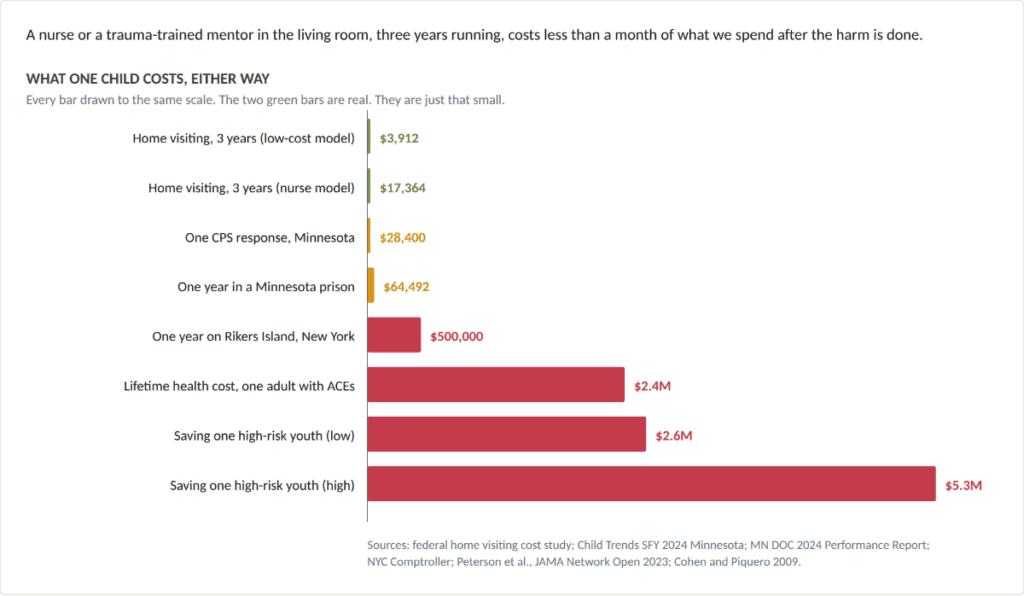
Line chart tracking one child’s cost to the public over a lifetime, from a $28,400 CPS response at age four to $2.6 million by adulthood
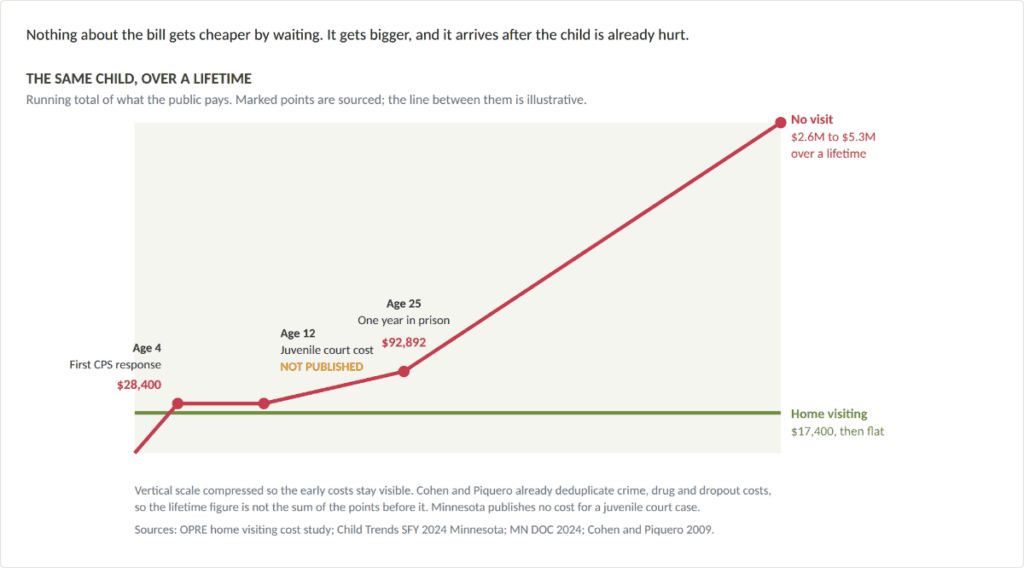
Chart showing the cost of child abuse across four generations of one family, reaching $9.6 million if the cycle is never broken
*Sources*
*Portilla, Ximena A., Kristen Faucetta, Kelly Saunders, and Amy Taub. “Beyond the Early Years: The Long-Term Effects of Home Visiting on Mothers, Families, and Children. Results from the Mother and Infant Home Visiting Program Evaluation.” OPRE Report 2025-052, September 2025. MDRC and the Office of Planning, Research, and Evaluation, U.S. Department of Health and Human Services.*
*”Costs of Evidence-Based Early Childhood Home Visiting: Results from the Mother and Infant Home Visiting Program Evaluation.” Office of Planning, Research, and Evaluation, Administration for Children and Families.*
*Peterson, Cora, and colleagues. “Economic Burden of Health Conditions Associated With Adverse Childhood Experiences Among US Adults.” JAMA Network Open, 2023.*
*Alper, Mariel, Matthew R. Durose, and Joshua Markman. “2018 Update on Prisoner Recidivism: A 9-Year Follow-up Period (2005-2014).” Bureau of Justice Statistics, 2018.*
*Cohen, Mark A., and Alex R. Piquero. “New Evidence on the Monetary Value of Saving a High Risk Youth.” Journal of Quantitative Criminology, 2009. And Cohen, Mark A. “The Monetary Value of Saving a High-Risk Youth.” Journal of Quantitative Criminology, 1998.*
*”Child Maltreatment 2023.” Children’s Bureau, Administration for Children and Families, U.S. Department of Health and Human Services.*
*Rosinsky, Kristina, Maggie Haas, and Alyssa Ibarra. “Child Welfare Financing SFY 2024: A survey of federal, state, and local expenditures,” Minnesota state factsheet. Child Trends, July 2026.*
*State of Minnesota Guardian ad Litem Board, 2026-27 biennial appropriation, omnibus public safety and judiciary law.*
*Minnesota Department of Human Services, “Out-of-State Children’s Residential Facility Placement Costs,” legislative memorandum, March 1, 2024.*
*Office of the Legislative Auditor, State of Minnesota, “Juvenile Out-of-Home Placement,” 1999, the most recent county-by-county accounting of placement spending.*
*Minnesota Department of Corrections, 2024 Performance Report, per diem information and adult recidivism update.*
*Washington State Institute for Public Policy, benefit-cost estimates for Nurse-Family Partnership, via the University of Pennsylvania Center for High Impact Philanthropy.*
*Kathleen Blatz statements as quoted in KARA’s published work at invisiblechildren.org and in the Star Tribune.*
*The Heckman Equation, “High-Quality Home Visiting Programs.” [PLACEHOLDER – the specific return-on-investment figure Mike wants to cite, with its own source.]*
https://www.mdrc.org/work/publications/beyond-early-years-long-term-effects-home-visiting-mothers-families-and-children
https://jamanetwork.com/journals/jamanetworkopen/fullarticle/2812583
Gehrman-R.-Karrow-M.-2023.-Minnesota-Child-Fatalities-from-Maltreatment-2014-2022.pdf
U.S. Census Bureau, Annual Survey of State and Local Government Finances, and Bureau of Justice Statistics, via USAFacts, state corrections expenditure per imprisoned person, 2023. New York City Comptroller, Department of Correction cost per incarcerated person.
For a deep dive into this topic, click here
INVISIBLE CHILDREN / KARA / KIDS AT RISK ACTION
This article contributed by former CASA Guardian ad Litem Mike Tikkanen
child abuse prevention
home visiting
child protection
foster care
ACEs
Minnesota
juvenile justice
prevention funding