Worker Bees Speaking Out

Many reading this post may not be in the job you are doing this time next year. DOGE and other Federal policy changes have determined that the work being done for at-risk children and families is either wasteful or like DEI the wrong approach to public policy. Attorney General Pam Bondi recently stated that significantly less than 20% of funding cuts will be reversed

Details

Part 4 of 5: Why Early Childhood Investment Outperforms Remedial Spending

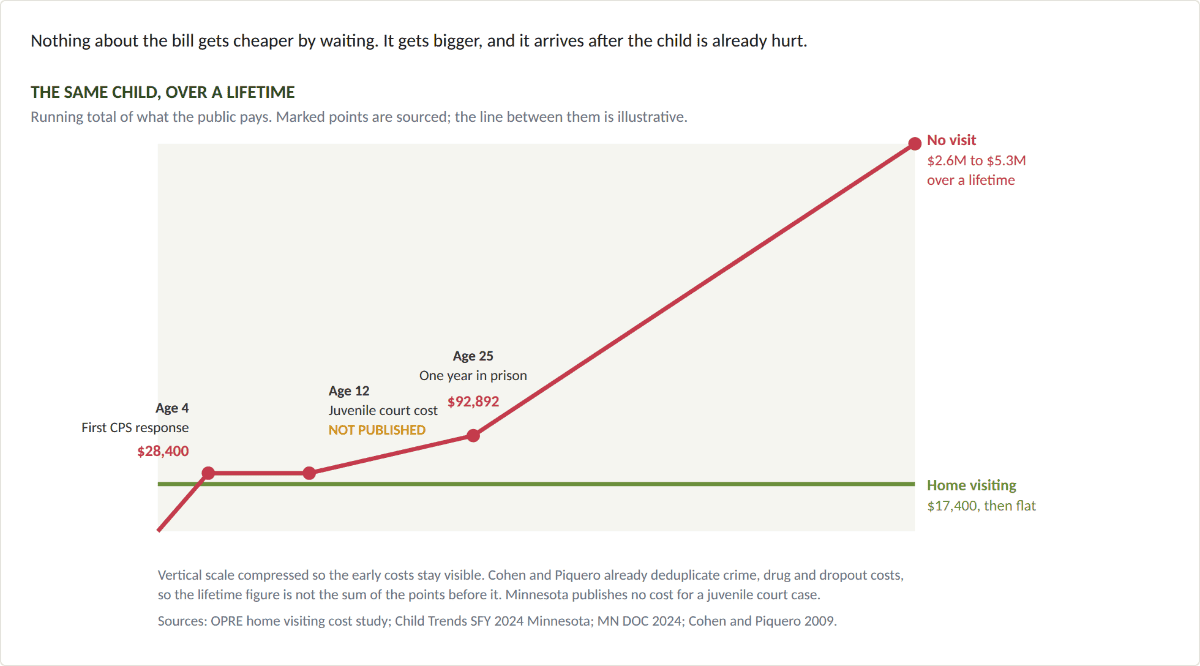
Compared to other government expenditures, early childhood programs are uniquely cost-effective. K–12 education spends ~$15,000/student annually with diminishing returns; prison systems cost $40,000/inmate yearly with high recidivism. Meanwhile, early childhood interventions like Head Start save $4.8B–$16.1B per

Details

Part 3: Scaling the “Minnesota Model” for Maximum ROI Impact

Market-based scholarship programs like Minnesota’s Early Learning Scholarships (MELS) prove these returns are scalable. MELS provides vouchers to low-income parents, empowering them to choose high-quality programs. Result: an 18% inflation-adjusted public ROI—higher than the S&P 500’s historical average111210. The keys to replicating this success are: Targeting at-risk children: Returns exceed $17 per dollar in high-poverty neighborhoods7. Parent empowerment:…

Details

Part 2: The Science Behind Early Childhood Returns (ROI)

The extraordinary ROI of early childhood programs stems from neurobiological and economic synergy. During ages 0–5, the brain forms 1 million neural connections per second, creating foundational skills that dictate lifelong learning, health, and behavior56. Programs like Child-Parent Centers leverage this plasticity: at-risk children receiving enriched preschool and parent mentoring achieved $10.83 in societal benefits per dollar spent by age…

Details

In Custody, In Crisis (podcast episode #1)

dive into the “ground truth” of the foster care system — exposing the often-unseen hardships children face even after being placed in protective care. Through heartbreaking stories like Alex’s and alarming statistics on abuse

Details

Foster Child Self-Harm & Suicide June 2025

Childhood trauma, suicide and self-harm among American youth are at historic highs, with alarming increases among fosters, preteens, girls, LGBTQ+ youth, and children of color. Suicide is now the second leading cause of death for ages 10–24, and nearly one in five high school students has seriously considered suicide in the past year. Rates of…

Details